
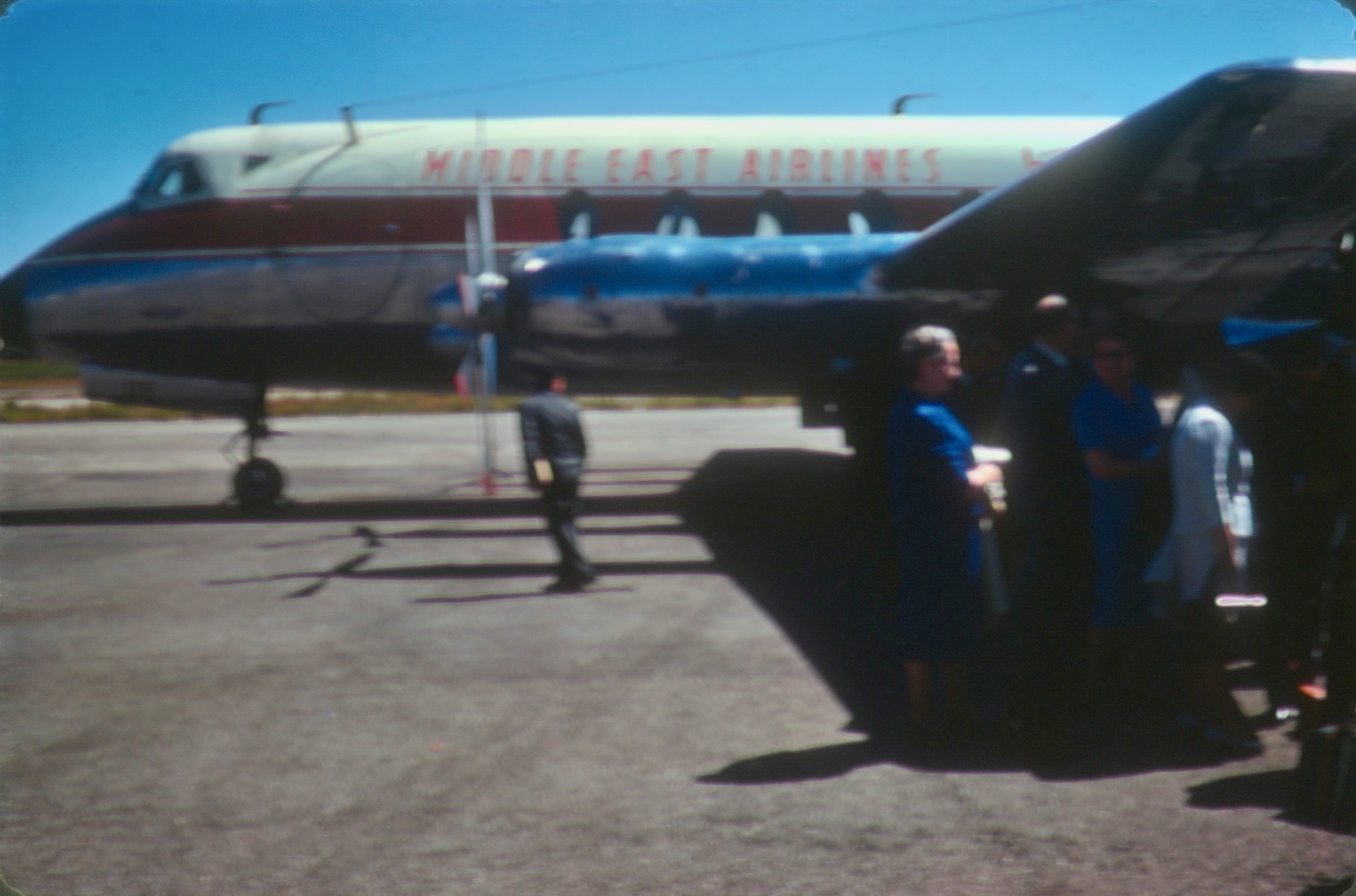
By the date of my first return from boarding school in December 1972, my parents had moved into their fourth house in Dhahran, a white stucco place on 16th street, which was then at the edge of town. By that time The Box had been rotated back to our house. I became used to people walking through our yard to the back patio, their arms full of paper bags, stuffed with old clothes. Through my childhood, no matter where The Box was, I would be drafted every couple of months, along with a few of my friends, to sort the clothes according to gender and size, mark each collection, and reseal the bags with heavy masking tape. As conscripted volunteers, we got a kick out of some of the items that would turn up. One prominent woman in the community donated her “old” mink stole to the cause along with a beautiful brocade skirt. Such “party” clothes weren’t quite what was called for, but we sent the mink stole because it gets cold in the hills and deserts Lebanon and Jordan. At the other extreme were overalls and work clothes that were too raggedy even to be given away; a baggy, tattered sweater that a spouse had finally disposed of. Often, we’d find a stuffed animal that after years of a careless toddler’s hugs was unrecognizable as any zoological species.
I don’t know how my mother gathered her intelligence, but she and the other women in her community group would know when somebody else was traveling to Jordan or Lebanon. A few bags would be pressed into the arms of these travelers for delivery to a local charity in Beirut or Amman or Ramallah, sometimes Jerusalem. The clothes would then find their way to “the Palestinian Refugees.” These words were always inseparable, like “United States.” I didn’t think about the meaning of the words separately; the fact that the residents of a certain geographic area had decided to call themselves “states” and that they had decided to become “united.” So it was with “Palestinian Refugees.” When I was little I knew of no other refugees. I didn’t know what these people needed refuge from or why they weren’t where someone thought they should be. I did know that these people needed my old clothes.
My one and only trip to “the Holy Land” as my parents called it came when I was very young, before the 1967 Six-Day War. We visited the missions and relief organizations, our arms laden with our share of the brown paper sacks. Growing up in the Middle East, I took for granted that a lot of people lived in poverty, that a lot of things were going on that nobody talked about and but it was up to us to help. We headquartered at the Charles Hotel, a nondescript place on a side street in the Lebanese capital, and visited the Boys’ Home of Onesiphorus where I saw the playground that my Sunday School class offerings of Saudi riyals had helped to pave. We traveled to the chilly hills of Ramallah, Jordan, to a girls’ school supported by our Fellowship in Dhahran.
Jerusalem I claimed as my own private reward for all the Bible verses I had ever learned. We checked into the American Colony Hotel on a sunny day in November and went to take tea. The Colony hadn’t started out as a hotel but as a group of American & Swedish Christians, among them a family from Chicago named Spafford. It was their daughter who was to be our hostess. Bertha Spafford Vester was a woman then in her middle eighties with white hair. She amazed me with her confidence and her kindness. I learned the source of it years later when I read her autobiography, “Our Jerusalem.” The Colony came to be a niche of calm and reason, carved out of a turbulent city at the turn of the last century. It was an extraordinary accomplishment achieved by quite ordinary people. Such is the power of compassion and common sense. The American Colony became an intellectual and often physical shelter in the decaying last years of Ottoman Rule and then as the British began governing the Middle East. In turn, it became a haven for Arab and Jew, Easterner and Westerner. Its dining rooms became battle hospital wards, its bedsheets became flags of surrender.
Our trips to the Holy Places of Islam and Christianity and Judaism were led by an Arab tour guide, Mouso Sawabini, himself an ordained minister in the Christian faith. He was the closest I would come to having a grandfather and I had him all to myself for a week. The stories of the Temple Mount, the Dome of the Rock, and the Church of the Nativity were made deep and real by his storytelling charm. We traveled to the hilly moonscape of the Dead Sea where I finally learned to float with the help of its salty, green water.
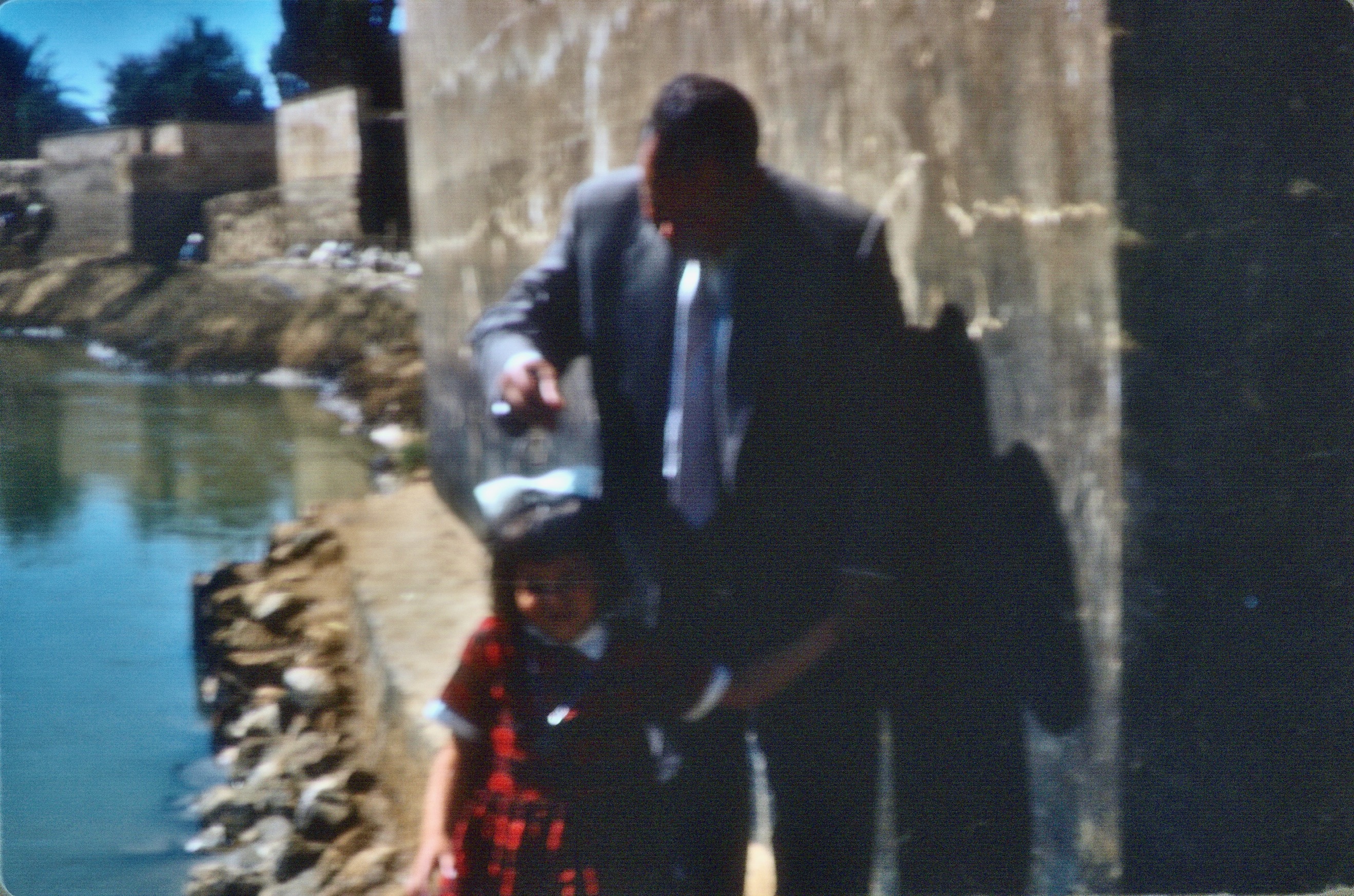
He drove us to a spot along the Jordan River, where it was said that John had baptized the Christ. He took my hand and led me down the bank. Stooping his old shoulders, he bent down to cup the cool water in his gnarled hand and brought his dripping fingers to the top of my head. In a heavy Arab accent I had heard all my life, he spoke the ancient words:
“I baptize you in the name of the Father, and the Son and the Holy Spirit.”
My shoulders hunched as the water dropped through my hair, and I stopped breathing.
On the day we were to return to Dhahran, I woke to find a present under my pillow. It was the first day of the Id al Fitr, the breaking of the fast of the holy month of Ramadan. The Christian Christmas was still a month away that year but Mouso had apparently felt that one religion’s holy celebration was just as appropriate as another’s for giving a gift. It was a silver crusader’s cross with a stone of green embedded in the center. I still this have this gift.
News reached us some years later that Mouso was dead, shot and killed during the Six Day War. My memories of Mouso remained as a witness to what is possible among us. If peace was to come to his land, it would happen two souls at a time, one face to one face, both realizing in a moment of stunning clarity that nothing else mattered.
I don’t know how it escaped the Saudi censors, but I remember picking up a copy of Leon Uris’ book, “Exodus” at a dusty bookstore in a town near Dhahran. It was my introduction to Israel as something other than a place I didn’t hear much about. If there was any news about Israel in the Time and Newsweek magazines my father brought home from the commissary every week, it would have been blacked out or torn out, with a note below: “The Saudi Arab government has removed pages so-and-so to so-and-so. No explanation was offered but we knew.
Albeit a novel – and some say a commissioned one — “Exodus”was my first look at the rest of the story. Through high school, I read more and more books about Palestine and about the amazing story of the Jews who would become Israelites once again. But as a diplomat said on the eve of the United Nations vote in 1948, it would not be a battle between “right” and “wrong,” but between two “rights.”
Many years after leaving Saudi Arabia, after having been raised by my Christian parents, an mtDNA test told me I was 98% Ashkenazi Jew — and 2% Russian-Finnish. The irony is too large to comment on. Through fifty years of thinking and reading about “the Middle East conflict, “it grows more complex for me. It is not just about Israelis and Palestinians, or Muslims and Jews and Christians. It is about petroleum and powerlessness. It is about water and wastelands. It is about the curse of dogma and the fierce love of precious places. It is about loss upon loss, with no respite or reconciliation.
Justifications for new violence, just as threadbare as the old ones, still show up on the news. The terror that rips apart bodies and souls still happens. The satellite feeds bring the same images of destruction, crying faces and bloody children. It takes our breath away for a moment, but we do not stay. We leave the issues of life and place and death and home. The arms, both human and machine-made, raised in outrage on both sides are drenched in enough blood to make keeping score an obscene and demeaning task. Along each dusty sideline and in the deadly middle, all the children are watching. Generations have lived with this hand-me-down chaos and danger, their exhausted psyches as worn and tired as the elbows on the jackets I used to pack.
 3rdculturekid: an american childhood someplace else
Lovely, Kimberly – a lovely piece. It sends me back to my own memories of censored materials in Saudi, of the poverty in the Middle East. Our family, too, visited the Holy Land in 1966 during our ‘short vacation’ and it all was quite impressionable to this then-ten year old. The Dome of the Rock, the Church of the Nativity, the Via Dolorosa, the market stalls – then on to visiting Galilee and Bethlehem and floating in the Dead Sea… The pain of the never-ending and centuries-old conflicts in the Holy Land hit me, too — why is that beautiful place so destined for conflict? How remarkable to find your DNA so predominantly Ashkenazi Jew! Thank you for sharing and writing!
Kimmie Gail…
<
div>Wh
Oh gosh Laurie Ann your comment didn’t come through! Thank you for reading tho!
Thank you so much for articulating the inexplicable…
Lovingly
am finally getting back to writing and lovely to see your note here. Yes, I agree, “Inexplicable.”